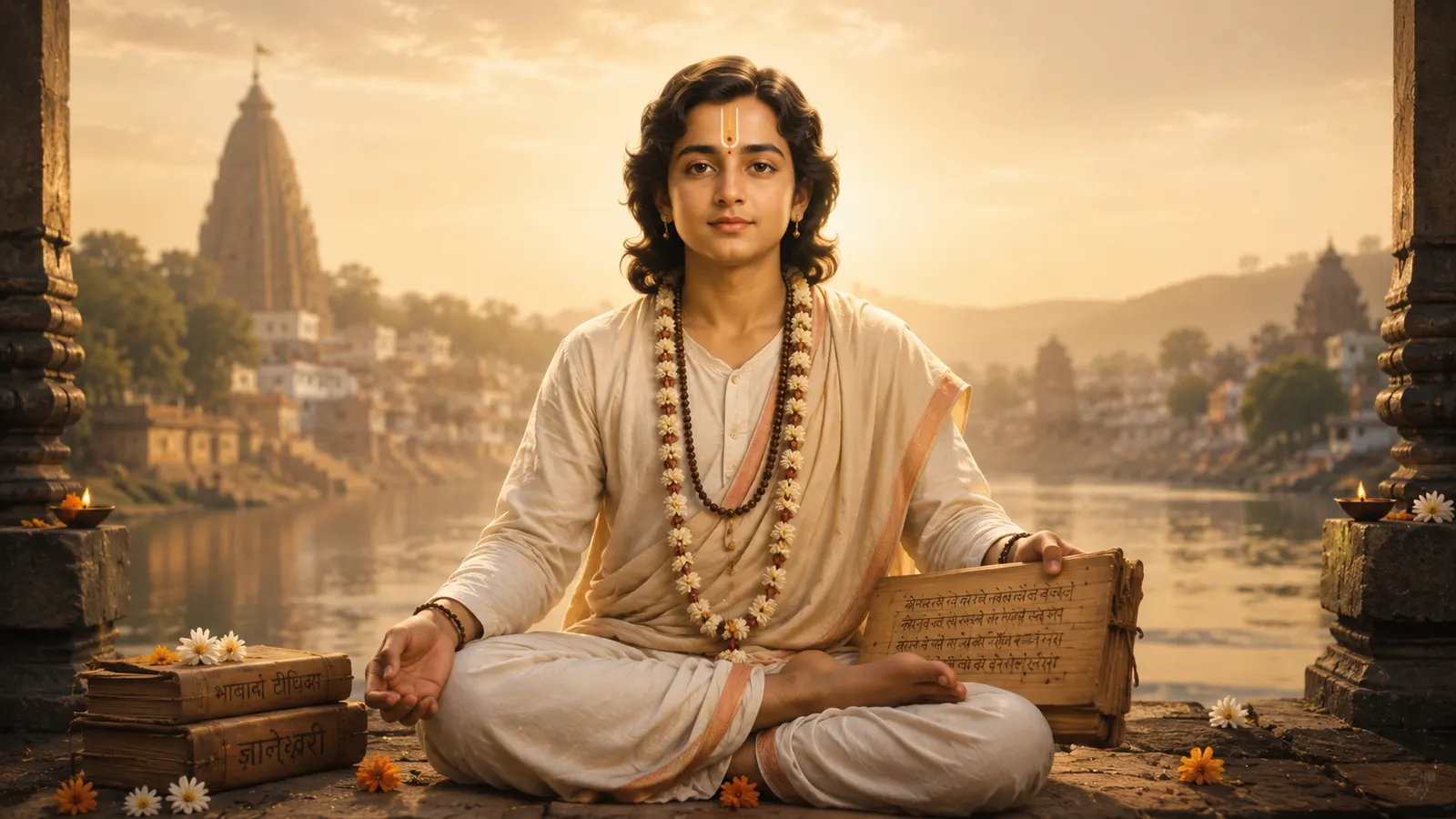
Jnaneshwar
“A young saint who made wisdom sing in the language of the people.”
Why he matters
Jnaneshwar lived for only a little more than twenty years.
Yet his voice changed the way spiritual wisdom could be heard in Maharashtra.
His Dnyaneshwari brought the teachings of the Bhagavad Gita into Marathi, joining knowledge, devotion, and poetry in a language that ordinary people could enter.
Centuries later, its prayer for friendship among all beings still travels with pilgrims toward Vitthal.
What you may feel with him


Wonder
When something you thought you understood suddenly opens into something much larger.


Inner clarity
The quiet feeling of seeing through confusion and returning to what matters.


Oneness
When the boundary between yourself and the world begins to feel less solid.


Devotion
When understanding stops being an idea and becomes a relationship with the Divine.


Belonging
The feeling that wisdom is not reserved for a few, but can become part of everyone's life.


Hope
The sense that inner transformation can extend beyond the individual.


Peace
The stillness that appears when the need to divide, control, or grasp begins to fall away.
Listen to his words
OnenessYou and I are one, without name or form.
Changdev Pasashti, verse 59
ClarityThe perfect meeting with the Infinite is eternally within ourselves.
Changdev Pasashti, verse 57
AweIt is the one pure Consciousness that becomes everything.
Changdev Pasashti, verse 12
PeaceOne who is ever contented and whose heart is full of satisfaction.
Dnyaneshwari, commentary on Bhagavad Gita 2.55
BelongingHari is equally in everyone.
Haripatha; final translation edition to be selected.
May all beings develop friendship for one another.
A moment from this life
One of the best-known stories surrounding Jnaneshwar involves the yogi Changdev.
According to devotional tradition, Changdev was a powerful yogi who wished to test the young Jnaneshwar. The story tells that Jnaneshwar responded not with confrontation, but with a demonstration of spiritual humility: he and his siblings are said to have approached Changdev while seated upon a wall, which then moved toward him.
This belongs to the traditional devotional account, not to established historical record.
Within the tradition, what matters is not the miracle itself. The encounter becomes a teaching about the difference between spiritual power and spiritual realization. The Changdev Pasashti, the sixty-five verses associated with the encounter, turns instead toward the disappearance of separation between perceiver and perceived, and toward the recognition of the Self as one.
Wisdom does not need to prove itself.
His journey
A life that made wisdom accessible, devotional, and shared.
Born in Maharashtra
A child born into a difficult family story.
Entered the path of spiritual knowledge
His elder brother Nivruttinath became his guru and introduced him to the Nath spiritual tradition.
Faced social exclusion
Jnaneshwar and his siblings grew up amid the consequences of their parents' controversial religious circumstances and were excluded by sections of their local Brahmin community.
Gave the Gita a Marathi voice
Around 1290, Jnaneshwar composed the Dnyaneshwari, a poetic commentary on the Bhagavad Gita in Marathi.
Deepened his spiritual teaching
He composed Amrutanubhav, an original philosophical work exploring consciousness, knowledge, and non-dual spiritual experience.
Walked within the world of Vitthal devotion
Jnaneshwar became closely associated with the devotional culture surrounding Vitthal and Pandharpur, alongside other early Varkari saints such as Namdev.
Took samadhi at Alandi
In 1296, according to established tradition, Jnaneshwar took samadhi at Alandi.
His journey continued through the Wari
Centuries later, his padukas are carried from Alandi toward Pandharpur in the annual palkhi pilgrimage.
Places to encounter him
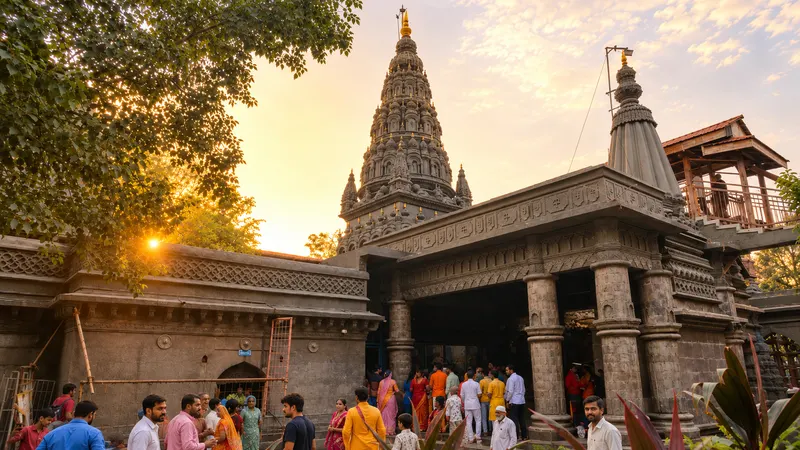
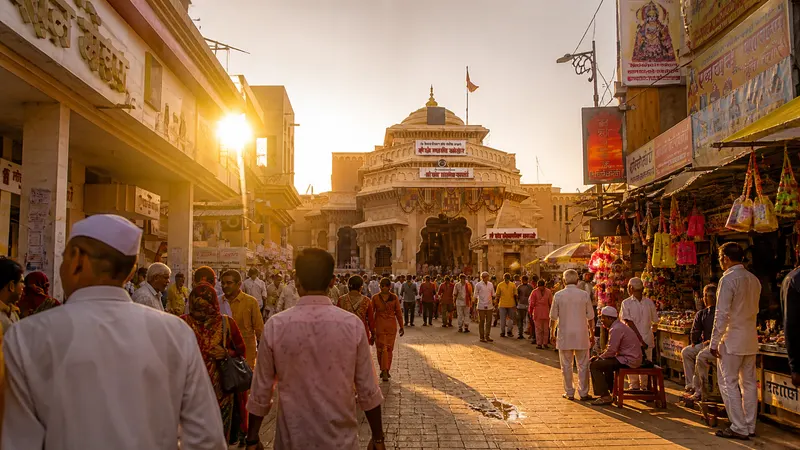
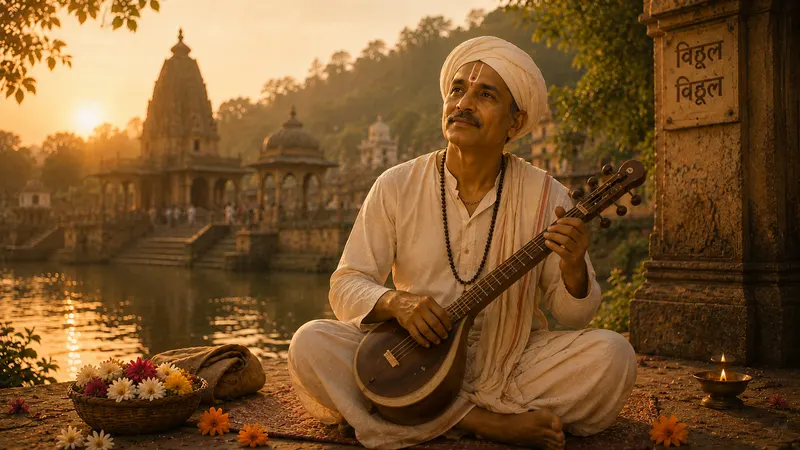
What stayed with you after meeting this guide?
His words began as a young voice in Maharashtra — and became part of a pilgrimage still walking toward Pandharpur.