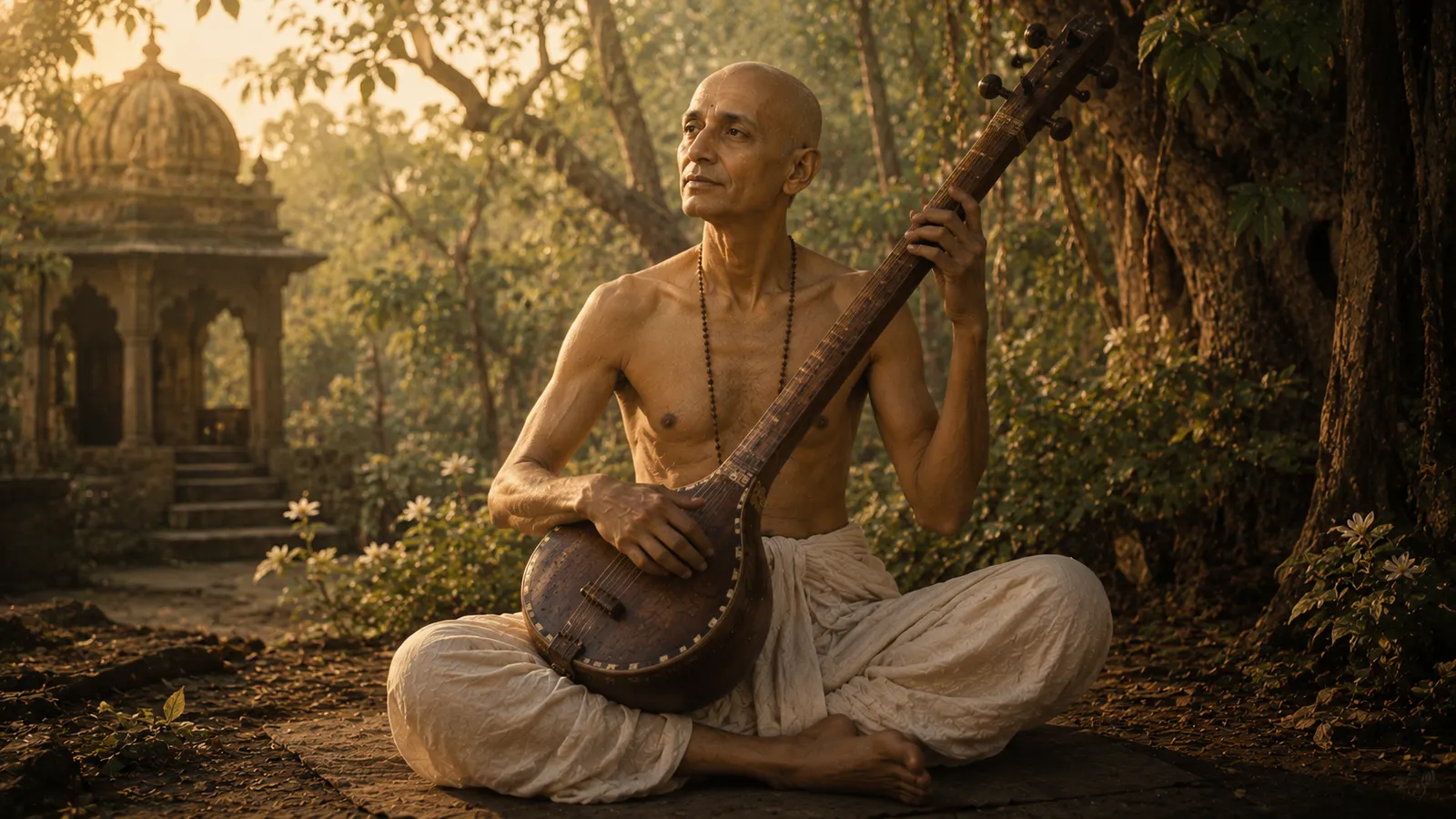
Swami Haridas
“He sang for no one but the Divine — until the Divine stepped forward to be seen.”
Why he matters
Swami Haridas was a hermit who wanted nothing from the world he'd left. He did not sing to be heard — he sang because devotion itself was enough. Withdrawn in a forest grove outside Vrindavan, he gave his life to music and poetry for Radha and Krishna as one inseparable love.
Tradition holds his devotion grew so complete he asked to see them united — the vision behind the image later worshipped as Banke Bihari. He's also remembered, more uncertainly, as the musician Tansen's first teacher, and as the root of a still-living devotional lineage.
What you may feel with him


A Song That Answered to No One Else
He is remembered for refusing to sing for kings or applause — only ever for the Divine.


The Ache Behind Every Note
His verses return to a yearning intimacy can't resolve — being near is never quite being one.


Loving Without Needing to Be Loved Back
Tradition holds he loved Radha and Krishna not for their favor, but as a companion content to witness their joy.


Two Seen as One
Tradition holds his devotion grew so complete he asked to see Radha and Krishna as one, not two.


A Sight Too Complete to Interrupt
He is said to have sung so completely for the Divine that an emperor had to hide just to listen.


A Forest That Kept Its Own Time
He withdrew into Nidhivan, a forest outside Vrindavan, and stayed — his devotion needing no audience.


Play as a Form of Worship
His poetry lingers on lightness — a glance, a spring festival, a garland tied in play — delight itself as devotion.
Listen to his words
DevotionI have not gone anywhere — listen, listen, O Radha, I swear it to you.
Swami Haridas, Kelimal 25, trans. Rosenstein (thesis p. 288)
LongingThe longer he was denied her, the longer he suffered — until she appeared, and his heart filled with joy.
Swami Haridas, Kelimal 28, trans. Rosenstein (thesis p. 291)
LoveAs I see myself in your eyes, do you see yourself in mine? I want to see only you.
Swami Haridas, Kelimal 6, trans. Rosenstein (thesis p. 269)
AweYour eyebrows are bows; the notches of your lashes hold the arrows of your glances — you alone are my life, you alone are my treasure.
Swami Haridas, Kelimal 64, trans. Rosenstein (thesis p. 328)
JoyCome, won't you — let us go and see the spring of Kunjabihari, among the young women in the fresh wood.
Swami Haridas, Kelimal 99, trans. Rosenstein (thesis p. 363)
I have such a desire to unite heart with heart, to bring body together with body — but then what would I look at, O beloved?
A moment from this life
This is a story remembered by tradition, not documented history — valuable less for what Akbar did than for what it reveals about how Haridas's tradition understood his devotion.
Devotional memory holds that Akbar, hearing of a hermit whose singing surpassed the court's, traveled to Vrindavan to hear him. Haridas, the story goes, sang only for the Divine — so Akbar hid nearby to listen unseen, and was moved enough to step out and bow before the saint he'd come to test.
The episode rests on an uncertain foundation (the underlying Tansen connection is itself considered unlikely by scholars), but its value isn't whether it happened — it's a devotion that asked for no witness, until someone dared to listen in.
His journey
A life withdrawn from the world, spent entirely on a devotion no one asked him to perform.
Born into devotional tradition
Devotional tradition places his birth in 1478 — though even his followers disagree on where, and on who Ashudhir was to him.
Took to renunciation
He turned from household life to asceticism in his youth, guided by Ashudhir.
Withdrew to Nidhivan
He settled at Nidhivan, a forest outside Vrindavan, and stayed there for life.
The vision behind Banke Bihari
Tradition holds his devotion grew so complete he asked to see Radha and Krishna as one — the origin of Banke Bihari.
Founded a devotional lineage
His way of worship — witnessing their love rather than seeking a share of it — grew into the Haridasi sampradaya.
Composed the Kelimal
He composed roughly 128 devotional verses — the Ashtadash Siddhanta and the larger Kelimal — and is remembered as a formative dhrupad figure.
Samadhi at Nidhivan
Tradition holds he never really left Nidhivan. His samadhi remains there, near the site of the Banke Bihari vision.
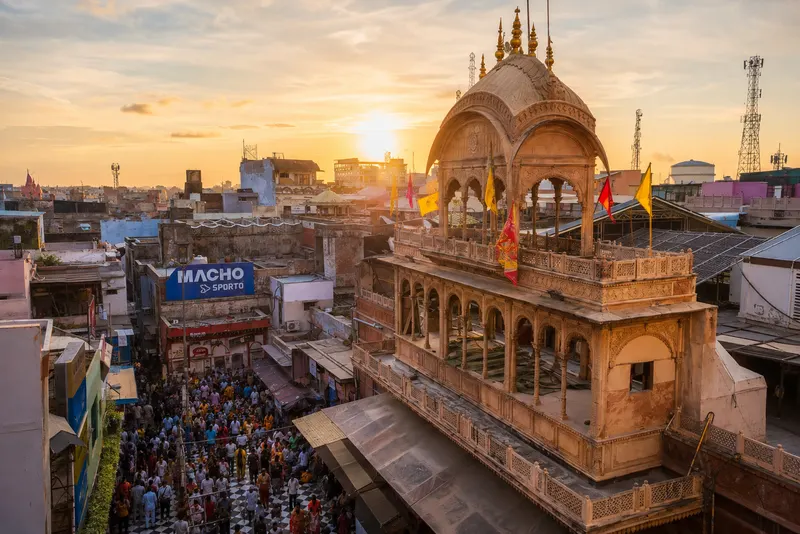
Places connected to his path
What stayed with you after meeting this guide?
He never sang for kings — only so the two he loved might, for once, be seen as one.